![Lakewood [Provisional] Post](https://lwppost.com/wp-content/themes/lpp/assets/img/masthead.svg?v=1789331641)

Lakewood police share data from the city’s 50 license plate cameras with 939 law enforcement agencies, 408 in Ohio and 531 in other states, Police Chief Kevin Fischer told City Council’s Public Safety Committee on Monday, October 12.
After council raised concerns, the department stopped sharing with two federal agencies, the Tennessee Valley Authority and postal inspectors, in May, and turned off Flock Safety’s nationwide sharing network, Fischer said. Agencies that want access now have to ask. He said 188 requests are pending and have not been approved because the department does not know why those agencies want the data.
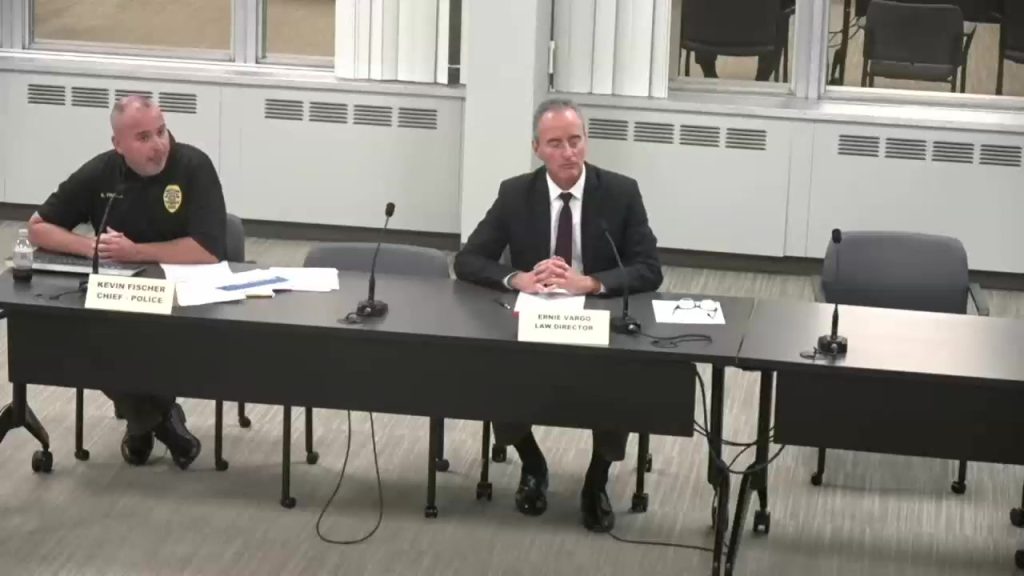
Council sent the contract to the committee in September at the request of Councilmember-at-Large Angelina Hamilton Steiner, who chairs it, Council President Sarah Kepple and Vice President Kyle Baker, after residents raised concerns about the cameras. The committee took no vote.
SOURCE · onelakewood.granicus.com · Checked October 15The October 12 Public Safety Committee meetingThe city pays Flock $125,000 a year. The contract runs to July 24, 2028, then renews automatically for 24 months unless either side ends it at least 30 days before, Fischer said.
Fischer said searches for immigration or reproductive health enforcement are disabled in the software, both for Lakewood officers and for other agencies searching Lakewood’s cameras. The department’s written policy, included with the meeting agenda, still says camera data is not to be shared for those purposes “without prior approval from the Chief of Police.” A resident pointed out the difference during public comment, and Hamilton Steiner said she would follow up with Fischer.
Images are deleted after 30 days unless an officer downloads them into a case file, and the department has discussed cutting that to two weeks, Fischer said. He said Flock, not the city, owns the images it stores. Law Director Ernie Vargo said he would check the contract on ownership. “Whether it’s ownership or another contractual provision, it is a certainty that our provider of this technology cannot share our data with anybody,” he said.
The department’s camera coordinator, a sergeant, is to audit a random sample of officers’ searches each month. The sergeant is on extended sick leave. Fischer said the sergeant would be better placed to answer whether audits cover searches of Lakewood’s cameras by other agencies, and he did not know whom those agencies share data with in turn.
Fischer asked council to keep the cameras, though not necessarily the company. “I’m not married to Flock,” he said. “In my 27 years of law enforcement, there’s been no bigger technological or investigative benefit than to have this technology.” He credited the cameras with leading detectives within 48 hours to the man who killed Lakewood resident Dawn Gibson at a Days Inn last year.
Council can fund the contract or not, but the policy belongs to the mayor, who as safety director could change it at any time, Kepple said. She suggested Shaker Heights’ recently rewritten Flock contract as a model for any new one; she said it restricts sharing with agencies that work with federal immigration enforcement under so-called 287(g) agreements. “When they’re feeling this pressure is a good time to push on them for what we want in our contract,” she said of Flock.
Baker said he trusts Lakewood officers with the data but not necessarily a private company holding it. “Where I get concerned is what other parties may be able to access that data and how secure we’re being with that,” he said. He wants to press Flock on data security, and to find out whether other providers offer better safeguards.
Four people spoke during public comment, all against renewing. Several said they trust Lakewood police but not Flock or the agencies the data is shared with. “I do trust the Lakewood Police Department,” one said. “I don’t extend that trust necessarily outside of the city.”
ENDFOR NOW